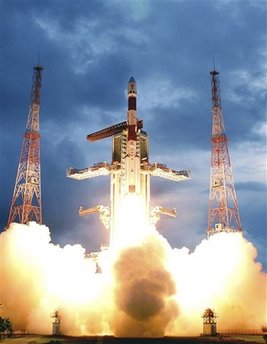
 On Wednesday, India became the third Asian nation to launch an unmanned probe to the Moon, following Japan’s Kaguya in October 2007 and China’s Chang’e later that year. Chandrayaan-1 (which roughly translates, from Sanskrit, as “Moon vehicle”) was launched aboard a PSLV-C11 rocket by the Indian Space Research Organization from Sriharikota at 6:20AM (8:50PM EDT Tuesday).
The probe’s main mission is to map the Moon: it will circle the Moon in a polar orbit for two years, looking for evidence of water and precious metals. It also includes the Moon Impactor Probe, which will detach and kick up dust, which the orbiter will analyze, looking mostly for helium-3 (a rare isotope—potentially more plentiful on the Moon—sought for its potential use in nuclear fusion power).
CNN’s Miles O’Brien emphasizes the importance of the mission: “We really don’t have a good map [of the Moon]. The goal is to come up with a very intricate, three-dimensional map of the Moon.”
The probe is carrying payloads from Britain, Bulgaria, Germany, Sweden, and the US, and India plans to share its data with them.