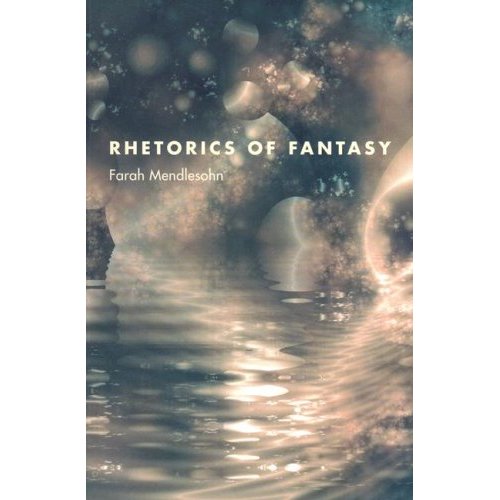
 Farah Mendlesohn‘s new study of the fantasy genre is entitled Rhetorics of Fantasy, and is being published by Wesleyan University Press this month. In the book, Mendlesohn “transcends arguments over the definition of fantasy literature to introduce a provocative new system of classifications for the genre. Mendlesohn looks at four categories that arise out of the protagonist’s relationship to the fantasy world. These categories are the portal-quest, immersive, intrusion, and liminal fantasies.”
Mendlesohn’s point is that authors’ stylistic decisions are shaped by “the inescapably political demands of the category in which they choose to write. For example, portal fantasies require that we learn from a point of entry. They are almost always quest novels and they almost always proceed in a linear fashion with a goal that must be met. Like the computer games they have spawned, they often contain elaborate descriptive elements. Yet while the intrusion fantasy must be unpacked or defeated, the portal fantasy must be navigated.” Another style, the liminal fantasy, is one in which “the fantastic leaks back through the portal. The tone of the liminal fantasy could be described as blasé. While liminal fantasy casualizes the fantastic within the experience of the protagonist, it estranges the reader.”
Mendlesohn uses these four categories to look at two hundred examples of fantasy fiction, ranging from 19th century works to some of the best books in the contemporary field. She has written the book for both scholars and fans.
Mendlesohn teaches at Middlesex University, London. She edited Foundation: The International Review of Science Fiction for six years, and is the author of Diana Wynne Jones and the Children’s Fantastical Tradition and the co-editor of The Cambridge Companion to Science Fiction. She is also the program director for Anticipation, the 2009 World Science Fiction Convention.