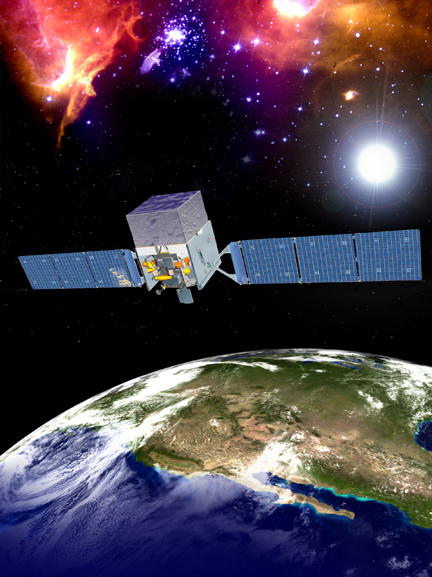
 Having nothing to do with yesterday’s launch of the space shuttle Atlantis, NASA is asking for help naming its next big space telescope. The cutting edge Gamma-ray Large Area Space Telescope, which is currently known by its acronym, GLAST, is scheduled to launch later this year. In orbit, it will observe some of the most powerful forces known in the universe. [See the NASA/General Dynamics illustration to the right.]
The public appeal to help name it is “to give people a chance to come up with a name that will fully engage the public in the GLAST mission,” said Steve Ritz, the mission’s project scientist at NASA’s Goddard Space Flight Center.
The mission’s scientific objectives are to:
* Explore the most extreme environments in the universe, where nature harnesses energies far beyond anything possible on Earth
* Search for signs of new laws of physics and what composes the mysterious dark matter
* Explain how black holes accelerate immense jets of material to nearly light speed
* Help crack the mysteries of the stupendously powerful explosions known as gamma-ray bursts
* Answer long-standing questions about a broad range of phenomena, including solar flares, pulsars and the origin of cosmic rays
NASA Associate Administrator for Science Alan Stern said “We’re looking for name suggestions that will capture the excitement of GLAST’s mission and call attention to gamma-ray and high-energy astronomy. We are looking for something memorable to commemorate this spectacular new astronomy mission. We hope someone will come up with a name that is catchy, easy to say, and will help make the satellite and its mission a topic of dinner table and classroom discussion.” Suggestions need not be acronyms. Suggestions to name it after a person may only include names of deceased people whose names are not already used for other NASA missions. All suggestions will be considered. The period for accepting names closes on 31 March.
To submit a suggestion for the mission name, see glast.sonoma.edu/glastname. NASA expects to announce the new name about two months after the telescope launches.
For more information about the GLAST mission, see www.nasa.gov/glast.