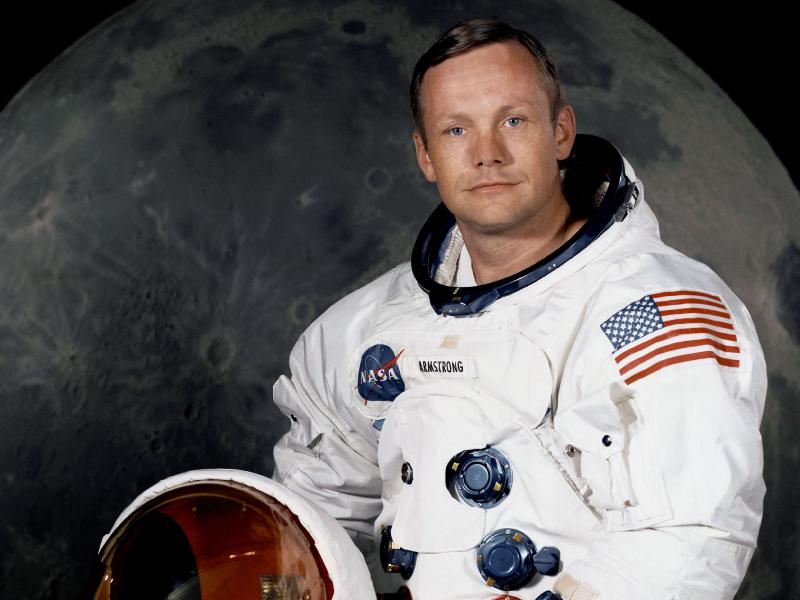
Portrait of Astronaut Neil A. Armstrong, commander of the Apollo 11 Lunar Landing mission in his space suit, with his helmet on the table in front of him. Behind him is a large photograph of the lunar surface.
Image Credit: NASA
Neil Alden Armstrong died 25 August 2012 following complications resulting from cardiovascular procedures. Born 5 August 1930 in Wapakoneta, Ohio, he was the first human being to step foot on the Moon.
Armstrong was a Naval aviator during the Korean War, flying more than 100 missions. After his naval service, he returned to Purdue University, where he earned a degree in aeronautical engineering degree in 1955. That same year, he joined the National Advisory Committee for Aeronautics (NACA), NASA’s predecessor, as a research pilot at Lewis Laboratory in Cleveland. He later transferred to NACA’s High Speed Flight Research Station at Edwards AFB, California, where as a test pilot he fly dozens of different aircraft. In 1960, he resigned his commission in the Naval Reserve, and in 1962, he was selected as an astronaut.
In March 1966, Armstrong first flew into space as the Command Pilot of the Gemini 8 mission, with David Scott as Pilot. Later, he was the backup Command Pilot for Gemini 11, and the backup Commander for Apollo 8 (he didn’t fly either of those missions).
Armstrong was then designated the Commander for Apollo 11, the first man to step on the Moon. The mission launched on 16 July 1969, touched down on the Moon on the 20th, and, at 2:56 UTC on 21 July 1969, Armstrong’s boot touched the lunar surface. Twenty minutes later, Lunar Module Pilot Edwin “Buzz” Aldrin joined Armstrong on the surface. They spent about two and a half hours walking around, setting up experiments, and gathering samples. After returning to the lander, they rested for about seven hours, and then prepared to leave the Moon, which they did two and a half hours later. In lunar orbit, they rendezvoused with the Command Module, piloted by Michael Collins, and returned to Earth, splashing down in the Pacific Ocean on 24 July.
Armstrong later served as deputy associate administrator for aeronautics in the Office of Advanced Research and technology at NASA Headquarters. He resigned from the space agency in 1971, and was a professor at the University of Cincinnati until 1979. Then he entered the business world, serving for ten years as chairman of Computing Technologies for Aviation Inc. of Charlottesville, Virginia, and later as chairman of AIL Systems Inc., an electronic systems company based in Deer Park, New York.
Armstrong was a very private individual, unassuming, and apparently uncomfortable with the public adulation that should have accompanied his status as “the first man on the Moon.” After leaving NASA, his public appearances were extremely rare. Buzz Aldrin, who is much more comfortable in front of the cameras, became the public face for “the first crew on the Moon,” but some of us who’ve been involved in commercial space programs have always wondered if public perception and support would have been different, stronger, if Armstrong had allowed himself to be more of a figurehead for people in space.
Armstrong is survived by his wife, two sons, a stepson, a stepdaughter, 10 grandchildren, and a brother and sister.
Armstrong’s family released a statement, saying (in part): “Neil Armstrong was a reluctant American hero who always believed he was just doing his job. He served his Nation proudly, as a navy fighter pilot, test pilot, and astronaut. He also found success back home in his native Ohio in business and academia, and became a community leader in Cincinnati.
“While we mourn the loss of a very good man, we also celebrate his remarkable life and hope that it serves as an example to young people around the world to work hard to make their dreams come true, to be willing to explore and push the limits, and to selflessly serve a cause greater than themselves.” The full statement is available here. More information is available, and updates will be posted, at http://neilarmstronginfo.com
President Barack Obama said of his passing, “Neil Armstrong was a hero not just of his time, but of all time. Thank you, Neil, for showing us the power of one small step.”
NASA Administrator Charles Bolden said, “As long as there are history books, Neil Armstrong will be included in them, remembered for taking humankind’s first small step on a world beyond our own.… Besides being one of America’s greatest explorers, Neil carried himself with a grace and humility that was an example to us all.” Bolden’s full statement is available here.
Apollo 11 Command Module Pilot Michael Collins said, “He was the best, and I will miss him terribly.”
Apollo 11 Lunar Module Pilot Buzz Aldrin said, “I am very saddened to learn of the passing of Neil Armstrong today. Neil and I trained together as technical partners but were also good friends who will always be connected through our participation in the Apollo 11 mission. Whenever I look at the moon it reminds me of the moment over four decades ago when I realized that even though we were farther away from earth than two humans had ever been, we were not alone. Virtually the entire world took that memorable journey with us. I know I am joined by millions of others in mourning the passing of a true American hero and the best pilot I ever knew. My friend Neil took the small step but giant leap that changed the world and will forever be remembered as a landmark moment in human history. I had truly hoped that in 2019, we would be standing together along with our colleague Mike Collins to commemorate the 50th Anniversary of our moon landing. Regrettably, this is not to be. Neil will most certainly be there with us in spirit.
“On behalf of the Aldrin family, we extend our deepest condolences to Carol and the entire Armstrong family. I will miss my friend Neil as I know our fellow citizens and people around world will miss this foremost aviation and space pioneer.”
Of the 12 men who walked on the Moon between 1969 and 1972, Armstrong is the fourth to die. Predeceasing him were Apollo 12 Commander Pete Conrad (2 June 1930–8 July 1999), Apollo 14 Commander Alan Shepard (18 November 1923-21 July 1998), and Apollo 15 Lunar Module Pilot James Irwin (17 March 1930–8 August 1991).
