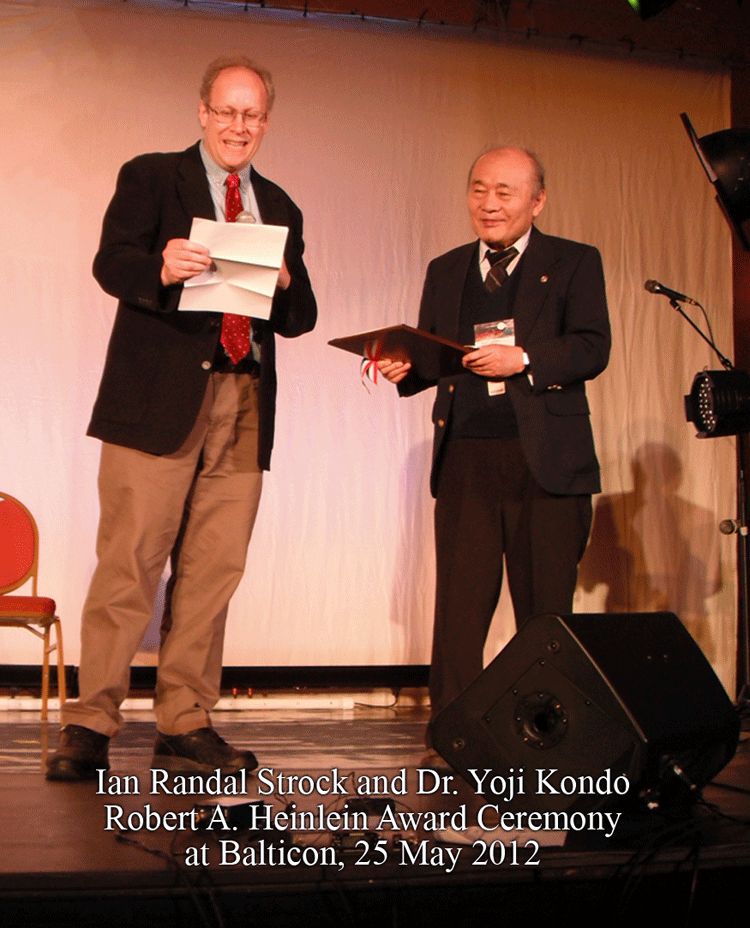
 Last Friday at Balticon, Dr. Stanley Schmidt (editor of Analog Science Fiction and Fact) was awarded the Robert A. Heinlein Award (see this article) for “outstanding published works in science fiction and technical writings that inspire the human exploration of space.” Dr. Schmidt was unable to attend, and asked me to accept the award for him. Dr. Yoji Kondo, chairman of the award committee, presented the award.
The photo at right shows me reading Stan’s remarks while Dr. Kondo holds the award. Below are my introductory comments, followed by his acceptance remarks:
My relationship with Stan goes back to my first days as a science fiction professional, twenty-three years ago. My first job was as the editorial assistant of Analog and Asimov’s science fiction magazines. Stan, as the editor of Analog, was one of my four bosses.
Three years after I started working at the magazines, I made my first sale as a writer to Analog. Three years after that, I realized none of my bosses had any thoughts of retiring, meaning there was no room for me to be promoted. So I struck out on my own, starting Artemis Magazine. My biggest fear in telling my bosses I was leaving them was that Stan would be upset with me. But when I told him, his first question was “Can I send you a story?”
I was pleased to buy and publish that story, and thrilled when it became Stan’s first Hugo- and Nebula-nominated fiction: it makes me one of the very few people to have both sold fiction to Stan and purchased it from him. Indeed, we still greet each other with “Hi, boss.” But more than that, we can call each other “friend.”
So I’m honored to accept this award on behalf of my friend, Doctor Stanley Schimdt.
Stan sent me the following remarks to share with you:
Acceptance Remarks for the 2012 Robert A. Heinlein Award
by Stanley Schmidt
I’m sorry I was not able to be here to accept the Robert A. Heinlein Award in person, but I assure everyone connected with its presentation that I am most grateful and deeply honored. I can think of no other award that would mean more to me.
Robert was one of my closest associates and best influences when I was growing up, even though I never met him personally until much later, and then only a few times. We spent many happy hours together, with me sitting in a deck chair on my parents’ front porch and my nose stuck in one of his books. I read a lot of them, beginning with the juveniles and moving on to the rest, and I learned a lot, including the importance of human exploration of space. In those days most of the people I knew—classmates and their parents alike—laughed at the very idea, but I already knew it was not only possible but vital to our kind’s long-term survival and certainly to our continued growth as a species. The Earth is, as we here all know well, too small and fragile a basket to keep all our eggs in.
But looking outward toward space was only one part of the whole package of ideas and attitudes I absorbed from Heinlein. I very much subscribed to his ideal of the “competent man”—or woman, for plenty of Heinlein’s heroines were impressively competent too. And by “competent” he didn’t just mean one kind of competence. I truly appreciated his long list of the things a human being should be able to do; you’ll find it in the Notebooks of Lazarus Long, summed up with the pithy statement, “Specialization is for insects.”
We’ve come a long way from the days when nearly everyone I knew scoffed at the idea of space travel. Some very influential people in the “real world” are now taking seriously the fragility of our little basket. We now know, for example, that errant asteroids can and do cause massive extinctions by impacting Earth. They’ve done it before and they’ll do it again; the question is not “whether” but “when.”
We’ve also learned that the Universe—even our little Solar System—is just full of resources that can benefit humanity, if we have the gumption and ingenuity to go out and get them. Just a few weeks ago, the world’s first asteroid mining company, Planetary Resources, Incorporated, was launched, with the express goal of combining those two ideas: seeking out potentially deadly near-Earth objects and converting them into assets.
Whenever I hear of something like this happening in reality, I can’t help thinking that its seeds were sown years earlier by stories and essays that planted the idea that such things were possible in the young minds of people who would later make them happen. That wouldn’t have been done by stories that merely bemoan the alleged wretchedness of the human condition and anticipate bleak futures. It’s painfully easy to imagine ugly, depressing futures; it’s harder, but much more rewarding, to imagine plausible ways we can steer clear of the terrible possibilities and build great ones instead.
I’ve always tried to keep that in mind in my own writing, both fiction and nonfiction, and in my editing. And I’m profoundly honored that the Robert A. Heinlein Award Committee has found my efforts in that direction deserving of this award. Thank you very much!