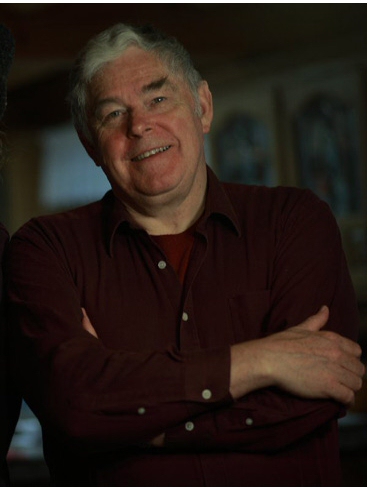
 Author James P. Hogan was found dead at his home in Ireland on 12 July 2010. Born in London, England, on 27 June 1941, he won three Seiun Awards and two Prometheus Awards.
Hogan studied engineering, and worked as a sales engineer in the 1970s. According to his own bio, he’d been writing science fiction as a hobby since seeing the movie 2001 and not understanding the ending. His first novel, Inherit the Stars, was the result of an office bet that he couldn’t write a science fiction novel and get it published. Del Rey published the book, and he won the £50 bet. The book was the first of what would become his “Minervan Experiment” or “Giants” series (continued with The Gentle Giants of Ganymede [1978], Giants’ Star [1981], Entoverse [1991], and Mission to Minerva [2005]). He quit his job to become a full-time writer at the same time he divorced his second wife, in late 1979.
That first novel was also first award-winner, taking the Seiun for best foreign novel in 1981 (he won the John W. Campbell Award for Best New Writer in 1979). Stand-alone novel The Genesis Machine (1978) won the same Seiun in 1982, and “Giants” novel Entoverse won it in 1994. Voyage from Yesteryear (1982) won the Prometheus Award in 1983, and The Multiplex Man (1992) won the Prometheus in 1993. His most recent novel, Migration, was published by Baen in May of this year. The Encyclopedia of Science Fiction offers this bio and bibliography of Hogan.
Hogan is survived by his fourth wife, Sheryl (his first three marriages all ended in divorce) and his six children.
My own memories of Hogan start with reading Voyage from Yesteryear, in retrospect probably very soon after it was published. I can still feel its influence on my political views. So I was thrilled when I got to meet him in the early 1990s. First, he visited the offices of Analog and Asimov’s, where I was working, and then I got to spend some more time with him that weekend, at a science fiction convention on Long Island. Now that he’s gone, I’m sorry it was so brief a time, but I did get him to sign that original copy of Voyage for me, and I did get to tell him that his book had some meaning for me. I’m sorry he’s gone.
Edited 23 July 2010: Dave Truesdale writes “In case you might be interested, I remembered that I’d done an interview with Jim Hogan back in 1993 (around the time you mentioned in SFScope you first met him when you were working at Analog/Asimov’s). I remembered it just last Sunday and transcribed it and worked it up and posted it at Tangent Online the same day. It’s here.
“I’d never met Jim before and had no idea what his politics were, though since his passing I’ve read all sorts of derogatory things about what he ‘supposedly’ believed. Whatever the truth may be, I still had a great time with him and we got drunk on a bottle of Bushmills Irish Whiskey during the interview. :)”
Here’s what he “supposedly” believed, from his own website, in praising the author of a book titled “The Hitler We Loved: http://jamesphogan.com/bb/bulletin.php?id=1179
But when an entire nation is accused of murder on a mass scale, claims that are wildly fantastic, mutually contradictory, and defy common sense and often physical possibility are allowed to stand unchallenged, truth is openly declared to be irrelevant, no evidence for defense is admitted, and even defense attorneys for the accused can be charged and imprisoned as being guilty of the same offense. Need it be said that truth does not need this kind of protection?
Adam Troy Castro also has an anecdote of Hogan saying that the Holocaust was “nonsense”. Wasn’t he delightful and wonderful!