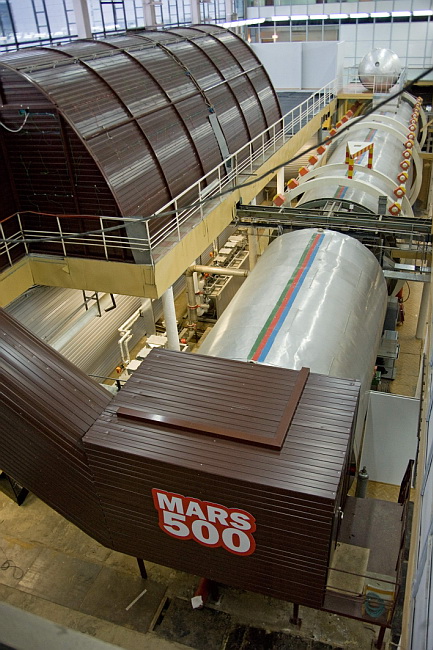
 Tomorrow, on 3 June 2010, six men will be locked into a 550-cubic-meter space (about 20,000 cubic feet) for 520 days to simulate a mission to Mars. The project, called “Mars-500”, is being conducted by the State scientific center of the Russian Federation—Institute for Bio-Medical Problems of RAS under the joint control of Roscosmos and the Russian Academy of Sciences. This will be the third phase of testing, following a 14-day isolation experiment conducted in November 2007 and a 105-day isolation experiment (completed in July 2009). The mission will simulate a 250-day journey to Mars, a 30-day surface exploration phase, and a 240-day return trip. (The photo at right is an external view of the test facility.)
This phase will include a series of experiments simulating aspects of an interplanetary manned flight. The main thrust of the test is to examine the effects of long-term isolation on the crew, who will communicate with the outside world via Internet, delayed and occasionally disrupted to imitate the effects of space travel. They will eat canned food similar to what the crew on the International Space Station eat, and they’ll take a shower once every 10 days, all to mimic the expedited living conditions in space.
The crew is made up of three Russians—38-year-old captain Alexey Sitev, 32-year-old Doctor Sukhrob Kamolov, and 33-year-old Doctor Alexander Smoleyevsky—one Frenchman (31-year-old engineer Romain Charles), one Italian-Colombian (27-year-old engineer Diego Urbina), and 26-year-old Chinese space training center employee Wang Yue.
Romain said “It’s not a jail, it’s a program, an experiment. It will be hard I’m sure, but we have a target to stay here 520 days and we will achieve it.”
A psychotherapist connected to the program, Mikhail Baryshev, explained the main goal of the program, which is to study the effects of long isolation to help a real space crew of the future cope better with stress and fatigue. “When everybody interacts with the same people in the same space, habits and behavior become apparent very quickly. These habits may irritate and cause indignation—and even fits of aggression.”
Updates should be available regularly on the Mars 500 web site.