 Comics historian and editor Greg Sadowski has signed a deal with Publisher Gary Groth of Fantagraphics Books to produce six new collections of classic comic book material. Sadowski was formerly a staff editor with Fantagraphics, but he’s now a freelancer.
Announcing the deal, Groth said “Greg has written one of the landmark cartoonist biographies (and only the first half yet!) with B. Krigstein, and the collections of comics from the ’40s and ’50s that he’s edited for us—B. Krigstein Comics and Supermen!, to date—have been meticulously assembled, with an eye toward selection, flow, and accompanying historical text. We’re pleased that he’s got such an ambitious agenda ahead.”
The books will be released one per season, starting in June 2010. Following are the descriptions Sadowski provided for his books:
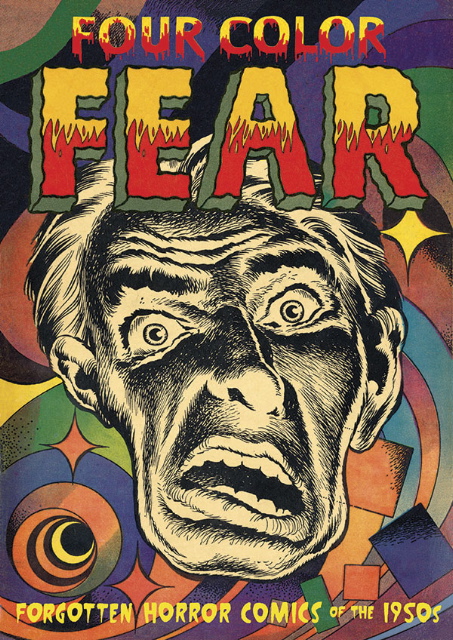
Four Color Fear: Forgotten Horror Comics of the 1950s will be a collaboration with John Benson, and will collect “the finest horror comics of the pre-code era (1950-54). EC is the company that most fans associate with horror, but to the average reader there remain unseen a tremendous volume of genuinely disturbing, compulsive, and imaginative stories from publishers such as Ajax-Farrell, Atlas, Charlton, Fawcett, Quality, Standard, and many more. Four Color Fear collects the best, and includes 40 full-sized covers. Featured are comic book legends such as Jack Cole, Steve Ditko, George Evans, Frank Frazetta, Alex Toth, Al Williamson, Basil Wolverton, Wally Wood, L.B.Cole, Matt Fox, and many others. In these types of compilations, I try to provide a service to the reader who has neither the time, inclination, nor bank account to purchase and sift through hundreds of golden age comic books to glean off that precious 10%—the most distinctive and worthwhile examples from a particular genre.”
Setting the Standard: Alex Toth at Standard Comics 1952-54 (scheduled for Fall 2010). “It’s hard to overstate the influence of Alex Toth on the art of comic books. Toth was from that first generation who grew up reading comic books, and he came to the medium armed with enough discipline, talent, and sheer love and respect for the medium to create a technique free of condescension, artifice, or shortcuts. His work at Standard first established him as the ‘comic book artist’s artist.’ Learning his craft at Eastern and DC, Alex Toth arrived at Standard Comics in late 1951 with a fully formed, graphically impeccable technique perfectly suited to the comic book medium—honest, uncompromising, and free of condescension and artifice.” The book will include a biographical sketch and an essay on Toth’s approach to comic book storytelling, based heavily on his interviews and written correspondence.
The Road to Plastic Man: The Golden Age Comics of Jack Cole 1937-41. “From his earliest days in comics, Jack Cole was one intense artist/writer. It just took him a few years to fully incorporate humor into his work, so this book tracks his artistic evolution leading up to Plastic Man. Jack Cole’s irreverent yet artistically first-rate approach to comic book art was a refreshing departure for a young industry that tended to take itself a bit too seriously. His work influenced many of his contemporaries, most notably Will Eisner, whose Spirit gradually assumed Cole’s intoxicating mixture of fun and high drama.” The book will begin with early “big foot” work for Centaur’s Funny Pages, then give way to raucous adventure and crime stories before honing in on the nefarious Claw, the boy inventor Dickie Dean, and proto-superheroes the Comet, Daredevil, and Silver Streak.
Away from Home: EC Artists at Other Companies. “The key ingredient in what made EC the most celebrated comic book company of all time was its remarkable stable of artists: Reed Crandall, Jack Davis, George Evans, Will Elder, Al Feldstein, Jack Kamen, Bernard Krigstein, Harvey Kurtzman, Graham Ingels, Joe Orlando, John Severin, Basil Wolverton, Wallace Wood, and Al Williamson, as well as that of part-timers Frank Frazetta, Roy G. Krenkel, Alex Toth, and Angelo Torres. This book will collect the best non-EC art by the EC stable of artists, in other words, the cream of the 1950s crop. A lot of these guys were pals and they often collaborated, so there will be a healthy sampling of these fraternal efforts.”
Creeping Death from Neptune: Basil Wolverton’s Sci-Fi and Horror Comics 1938-55. “Many of Wolverton’s comics have been reprinted in a number of formats, but for years I’ve been waiting for a full-color compilation of his serious golden age work. Finally I decided to do it myself. Like the Cole book, this one is a no-brainer. Given the media coverage of his recent retrospective at New York’s Barbara Gladstone Gallery, it’s high time for a full-color anthology of Basil Wolverton’s serious comic book work. This edition will cover all bases, from his early features, Space Patrol and Meteor Martin, into Spacehawk (‘Lone Wolf of the Void’), and ending with the skewed master’s gloriously repugnant horror comics.”
The Comic Book Frankenstein: The Monster According to Dick Briefer. “Dick Briefer had been involved in comic books since the earliest days. He was one of the first to work at Will Eisner and Jerry Iger’s comic book studio in the mid-1930s. Like Eisner, Cole, and Wolverton, Briefer was responsible for the complete package: writing, layouts, pencils and inks, and often the lettering. He did his best work on Frankenstein, and this compilation should restore his status as one of the form’s major pioneers. Briefer’s Frankenstein made its debut in 1940 in Prize Comics. He continually ramped up the monster’s humorous aspect, which in turn increased its popularity, and Frankenstein was rewarded with its own title in 1945. Then, with the horror craze in full swing in 1951, Briefer responded by reverting the character back to its frightening origins. This book will travel through Briefer’s complete Frankenstein series and shed light on one of comic books’ most gifted creators.”