 Copyright © 2009 by Michael A. Burstein
Alien Trespass
Written by Steven Fisher from a story by James Swift and Steven Fisher
Directed by R.W. Goodwin
Starring Eric McCormack, Jenni Baird, Dan Lauria, and Robert Patrick
Rated PG
90 minutes
Ah, the 1950s. A simpler time. A time when men and women knew their place in the world, when juvenile delinquency was represented by the one greaser kid in a leather jacket, when everything was black and white, and when you knew you could always trust your local police.
A time when all we had to be afraid of was weird rubber aliens attacking the Earth and trying to kill us all.
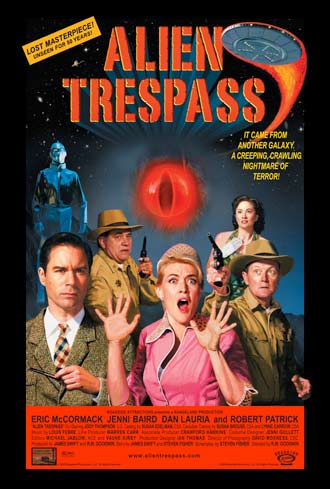
Director R.W. Goodwin remembers that time fondly and brings it back to life again with his new film, Alien Trespass. The conceit of the film is that Alien Trespass was actually made in the 1950s, but due to a legal dispute the head of the studio destroyed every copy. This is set up very nicely by a short fake newsreel at the start of the film, which also has the added benefit of creating the proper tone for the audience as the story begins.
Eric McCormack plays Ted Lewis, a bold astronomer celebrating his anniversary with his sexy wife, Lana, played by Jody Thomspon. On that same night there is a meteor shower, and Ted sneaks off to investigate. It turns out that meteors weren’t the only thing falling near the small desert town of Mojave, California. An alien marshal named Urp was ferrying a creature called the Ghota to justice when the Ghota caused the ship to malfunction so it could make its escape on our planet. The Ghota, a tentacled menace with one large eye, can turn invisible, and it (naturally) feeds on people. It’s also going to replicate itself if Urp doesn’t catch it in time.…
The movie is hokey in many places, but the hokeyness works. The inherent humor in the film comes from the earnestness with which the actors play their parts. The key in a movie like this is that it’s funny for the audience because the characters take everything so seriously. In fact, it’s not too hard to imagine that a 1950s audience would take the film just as seriously as the characters.
The film plays with all the tropes and stereotypes, and does so adroitly. Dan Lauria (Chief Dawson) and Robert Patrick (Vernon) are the law enforcement authority figures who refuse to accept the evidence of an alien invasion that is occurring in front of their own eyes. Andrew Dubar (Dick) and Sarah Smyth (Penny) play the two prim and proper teenagers who witness the spaceship crash but can’t get anyone to believe them except the non-threatening leather-jacket-clad greaser Cody (Aaron Brooks).
Eric McCormack does double duty as both Ted and Urp, since the alien marshal needs to occupy his body to find the Ghota. His performance is witty, and he deftly slips from Ted’s self-assuredness to Urp’s confusion.
As for actress Jenni Baird, who plays the diner waitress Tammy, the word that comes to mind to describe her portrayal is spunky. It’s easy to see why the alien Urp is so taken with her. Baird really makes the film her own, as the invasion of the Ghota gives Tammy a chance to prove to the world around her that she can do more than just sling hash all day. This is probably the only aspect of modern sensibilities to leak into the film, as the heroine of an authentic alien invasion film from the 1950s probably wouldn’t take charge of the situation as much as Tammy does. In the end, though, it works well for the film, as Tammy is the character who experiences the most growth.
In many ways the movie reminded me of the musical The Drowsy Chaperone, which had its Broadway opening in 2006 but was presented as if it was an obscure musical from 1928. By giving the movie the frame that they do, the filmmakers give the audience license to enjoy themselves.
It’s obvious that everyone working on this project had a lot of fun with it, and it shows. Anyone familiar with the tropes of a 1950s alien invasion movie will enjoy the film. And everyone will find a lot to laugh at.
Delightful and charming, Alien Trespass is the best new film of the 1950s.
Three out of four stars.
[Note: Editor Ian Randal Strock also reviewed this movie, in this article.]