by Sara M. Harvey
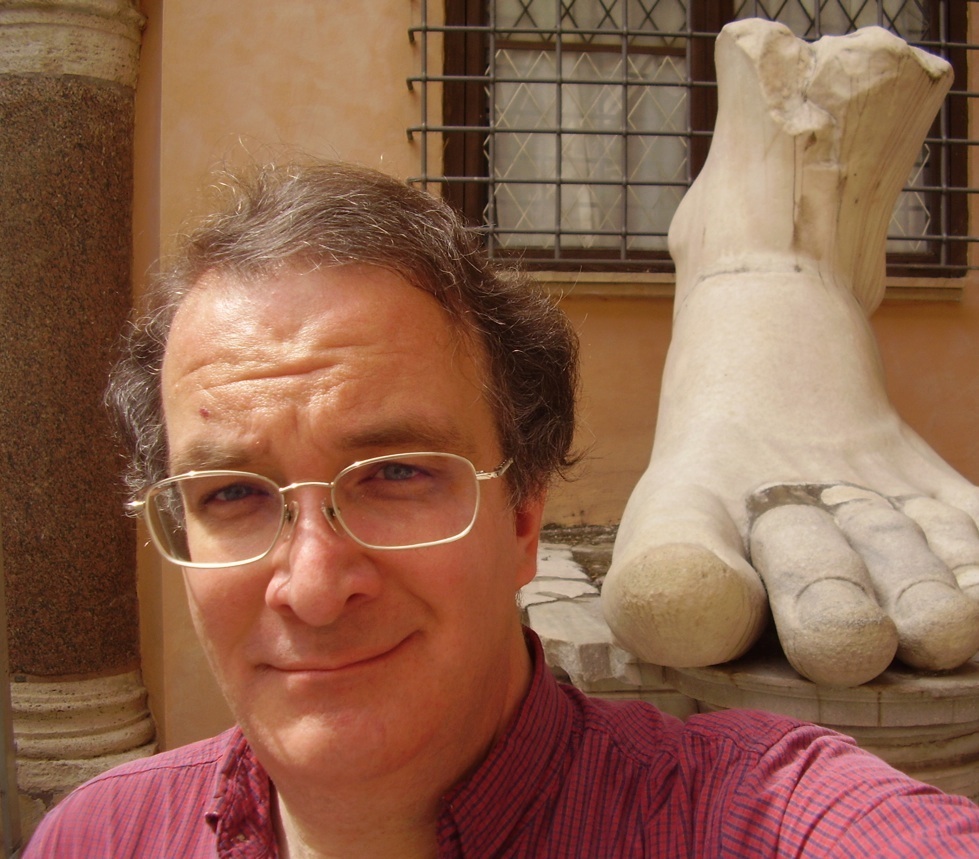 James Enge lives in northwest Ohio. He teaches classical languages and literature at a medium-sized public university. His stories have appeared in Black Gate, at Flashing Swords, at Every Day Fiction. He can be reached through his web page (jamesenge.com) or his blog. His novel, Blood of Ambrose, was just published by Pyr Books. In this interview, novelist Sara M. Harvey talks with Enge about his writing and the world of Morlock Ambrosius, which is the setting for nearly all of his published fiction.
Sara M. Harvey: So, Mr. Awesome-Fantasy-Writer Enge, what brought you to writing? And what magic does fantasy hold for you?
James Enge: The full name is His-Sir-Excellency-By-the-Power-of-Grayskull Enge, but I usually just stick to James.
When I was a kid I took too seriously Tolkien’s offhand comment that The Lord of the Rings was too short, and I set out to write a five-volume novel, which I got about twenty pages into before I abandoned. Still, that was the beginning.
I think I liked, and continue to like, fantasy because it expresses to me (in a way that realistic fiction doesn’t) how strange life is.
SMH: You have created a very complex and detailed world in which to place your stories and books, tell me a little about that world.
JE: It’s flat—or shield-shaped, more precisely—with three moons and a sun that rise in the west and set in the east. That’s been awkward sometimes, but I want a handy way to remind the reader (and myself) that this isn’t Earth. (Also, I found designing a pocket cosmos to be weirdly amusing.)
There are two continents: Laent (in which most of the action has happened so far) and Qajqapca. And no elves. For one thing, I think Tolkien Mary-Sued them into unusability (at least for me; I’m always happy when more talented writers prove me wrong about stuff like this). For another, I think that they belong to a higher kind of fantasy than I’m usually interested in writing.
SMH: What are some of the things that you find most important in world-building?
JE: Differentness is very important. If the world is just like the one we know, why go there? Also, the difference should have an impact on the story. In sf/f, the setting should always be part of the story.
SMH: I can imagine that utilizing a set universe can be a boon but also a pain. What are some of the pros and cons of interweaving so many tales into the same world?
JE: The biggest con is the need for consistency. For instance, between writing “Turn Up This Crooked Way” and Blood of Ambrose, I changed my mind about how many days there are in a year. There’s only a limited amount of stuff like that I’ll be able to get away with.
The biggest pro is that, if the stories work for people, it creates a denser, more layered experience. I introduced the corrupt city of Sarkunden in “Payment Deferred” and brought Morlock back there in “Payment in Full”. If the city is ever attacked by dragons or the Khroi or somebody, people who’ve read those two stories might get an extra charge out of the sense that this is happening to a place that they know. The trick would be to also make the events meaningful to people who haven’t read the earlier stories: that’s one of the challenges of writing an open-ended series.
SMH: Morlock is your main man, tell me a little bit about him! He is a really interesting guy, I have been enjoying reading over his adventures. How did he come about?
JE: I’m glad you like him. Morlock snuck into a long and hopelessly stupid multistage novel that I was writing thirty or so years ago. Everything else in those books eventually went into the ever-hungry maw of the writer’s best friend, but I kept returning to Morlock and messing about with his biography and his world. In some ways, he’s depressing, I guess: he’s a drunk who’s trying to keep from drinking; he’s faced a lot of frustrations and personal disasters. But he enjoys exercising his considerable talents, and once he decides to do something he never gives up.
The genesis of Morlock was, I think, frustration with two of my favorite writers, Tolkien and H.G. Wells. I was annoyed that Tolkien so obviously favored elves over dwarves, and that Wells did the same with Eloi over Morlocks. Morlocks did stuff—they worked and learned and thought and created. They seemed to me more authentically human than the empty, shiny Eloi. So what if they lived underground and weren’t so pretty? The cannibalism is a little harder to stomach, as it were—but I’m sure that’s exactly why Wells put it in. That’s his thumb on the scale, trying to tilt our judgment of his characters.
At the same time I was reading a bunch of Arthurian stuff, and “Morlock” looked like a lot of the names in those stories: Morgan, Morgause, Morholt, Mordred. So I got the idea of this Morlock Ambrosius, who would have something to do with dwarves and was also connected to the Arthurian mythos (as the son of Merlin and Nimue, it eventually turned out).
 SMH: On your blog, you mention that although your series has three books, it is not a trilogy in the traditional sense of the word. Could you expand on this?
JE: A trilogy could be three related books, conceived as a limited set, or a single narrative that sprawls over three volumes (like The Lord of the Rings). But each of the Morlock books is a standalone, and the series may (hopefully will) have more than three entries. I like long stories (for example, LotR, of course, and Joe Abercrombie’s recent “First Law” trilogy). But it seems like there are a fair amount of those on the bookshelves these days and I wanted to do something a little different.
Also the word trilogy may make some panicky reader think, “This is going to be one of those things where stuff happens in the first book, but in the second book the characters blunder around playing solitaire and polishing their belt buckles, and stuff starts happening again toward the end of the third book.” Whatever their other faults, the Morlock books really aren’t like that: the plot that begins in medias res on page 1 of Blood of Ambrose has been fully resolved by the end of page 390.
SMH: In the Morlock stories published through Black Gate, you work with illustrator Chuck Lukacs. What is that process like? How much input do you have on the look and feel of the images?
JE: There was no feedback process at all—I wrote the story, John O’Neill (Black Gate‘s great editor) sent the story to Chuck, Chuck sent the art to John, John showed the image to me, and I said, “Wow!” I think he brilliantly evokes the stories without slavishly depicting any particular incident. The art for “Payment Deferred”, for instance, shows Morlock holding up a glass eye and looking at it critically. Nothing like that actually happens in the text, and yet somehow that is what the story is about. Chuck is awesome, and the world should sing his praises.
I was also very lucky with the artist who did the cover for Blood of Ambrose—Dominic Harman did a wonderful job, and obviously shares my deranged love of crows.
SMH: I see that you are an instructor of “classical languages”, what makes a language “classical”?
JE: Any language can have a classical period when its norms are established, but in the narrower, older sense, “classical” just means Latin and Greek. I do more Latin than Greek these days—and, in fact, a lot of the time I’m teaching about the ancient world in translation (in courses about myth or Roman civilization).
SMH: You definitely have a definitive voice in your writing, how do you think your language background contributes to it?
JE: Could be… There’s a crunch and a flavor to the ancient stuff in their original versions that never quite comes through in translation, and there are times I try to echo that (or steal it). And I spent a lot of time in grad school working on medieval languages (Old English and Old Icelandic), although I haven’t had a lot of time to pursue those interests recently. But, honestly, I wish my language background was more varied—I haven’t studied any non-IndoEuropean language (except Hebrew; and that was a long time ago and I was a B student at best). I think that may narrow my outlook.
SMH: You live in the upper Midwest, in Ohio—a place where a lot of new authors seem to be coming from. How do you feel your environment contributes to your writing?
JE: It really is freaky how many sf/f writers are working in Ohio these days. I have no explanation for it—I think of myself as a expatriate Minnesotan (and maybe that contributes something to Morlock’s identity as an exile).
Ohio is full of fascinating places: the Appalachians in the east, the freshwater ocean of Erie in the north, the historic—even mythic—Ohio River in the south, the rolling hills in the center of the state.
My surroundings aren’t so picturesque: I live in a place that used to be called the Great Black Swamp before it was drained for farmland—there aren’t many topographical features, except corn. But there is some interesting regional history and a local ghost (the headless motorcyclist of Bowling Green). When I get a chance I like to sneak up north to Michigan or Minnesota. The northern woods and lakes tend to haunt my imagination.
SMH: As a college professor myself, I know the trials of finding balance between my academic and creative lives, how do you find time to do it all? Do you have some good tips on maintaining the harmony of an author with a day job (especially when that day job is not the average 9-5 variety)?
JE: It is tricky. I find, though, that the stuff I do in my day job feeds my imagination, gives me stuff to dream about and make into stories and worlds. I think my obsession with stories and storytelling helps my teaching, also. The danger is that the analytical processes suitable for academic writing and analysis of literature is completely toxic for storytelling directed at a non-academic audience, whereas the deftness and emotionality of effective storytelling will alienate an academic audience. And I’m not sure I ever have found a really good remedy for that yet.
SMH: In addition to the fiction and the academics, you also keep a blog, maintain a website, and guest blog here and there. What value do you think blogs and a web presence have for an author? How do you use these to your advantage?
JE: I can’t say for a fact that blogging, etc., does have a career advantage. I like it, and I like the people it brings me into contact with (many of whom I wouldn’t otherwise know, probably). But I think that I’m in a very different position from someone like John Scalzi or Cory Doctorow who cast huge shadows over the internet and genre culture.
For me, the biggest benefit is social and intellectual. The internet is this huge conversation going on all the time, and lots of it is focused on the genre-stuff I find interesting. Many of the people talking, especially those talking loudest, are, of course, idiots. But very many of them are not, and talking about stuff that matters to you with people who are not idiots is always an enriching experience. So that’s how I think of my blog: one more book-lined room in that endless mansion of conversation.
SMH: What about conventions? You were recently a guest at an online convention, FlyCon. How do you think the conventions scene helps authors?
JE: Well, FlyCon was a riot, but it was my first brush with the convention world, so this is one of those things I don’t really know about. I’m hoping it’s not crucial to a new writer’s career, though, because I’m not going to be able to travel much this year.
SMH: You have been working a lot with Pyr. Tell me a little bit about them and your experiences with them. A fiction branch of a publisher that usually puts out non-fiction books in science has got to be cool!
JE: Pyr’s original mandate was just to print science fiction, but they recently started branching out into fantasy and I lucked out when my brilliant agent Mike Kabongo submitted Blood of Ambrose just after they’d had a big success with the first volume of Joe Ambercrombie’s “First Blood” trilogy, which is a gritty sword-and-sorcery sort of fantasy.
My considered view is that every writer in the civilized world should have Lou Anders for an editor. He’s deeply involved in every aspect of the book—from the selection of manuscripts, (he doesn’t use readers), the editing in a more traditional sense, the commissioning of art—everything. I’m not saying he does it all; there are very talented people in design, promotion, copyediting etc., but he’s the unifying presence. He is incredible.
SMH: And finally what do you like to read?
JE: Well, stop me if I go on too long. The old guys never get old for me—Virgil and Seneca and Ariosto and so on. And I read lots of sf/f, of course—I’ve heard about people who write it without reading much of it, but I’m not sure I get the point of that. Older genre stuff—like Leigh Brackett, Fritz Leiber, Kuttner & Moore—is a perennial favorite of mine. But I also enjoy some of the newer sf by people like Scalzi and Charles Stross. Neal Stephenson is a guy who’s been publishing for a long while but whose stuff I only recently got into—I’m not exactly on the cutting edge of these things. And I’ll read anything Lois McMaster Bujold or Ursula K. Le Guin want to write—sf, fantasy, circus reminiscence, revolutionary manifesto—it’s bound to be good.
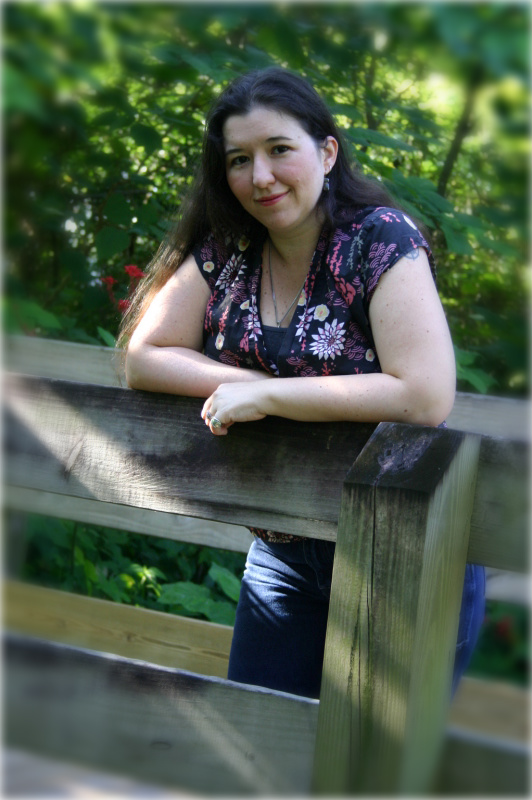 Sara M. Harvey is the author of The Convent of the Pure from Apex Publications. Look for the next novella in the trilogy in late 2009. Her debut novel was A Year and a Day, a romantic urban fantasy published in 2006. Sara is also a costumer and works as an assistant costume designer, an instructor in costume and fashion design, and a contributor to costume history textbooks. She lives in Nashville, Tennessee, with her husband, Matt, and their dogs, Guinevere and Eowyn.