The Heinlein Prize Trust has announced the winner of its microgravity research competition: the University of Texas Health Science Center’s Division of Nanomedicine, for their “Decoupling Diffusive Transport Phenomena in Microgravity.” The winning project is focused on the development of the science and technology for controlled, long-term drug release. This research, conducted in space, could yield important cancer treatments here on Earth.
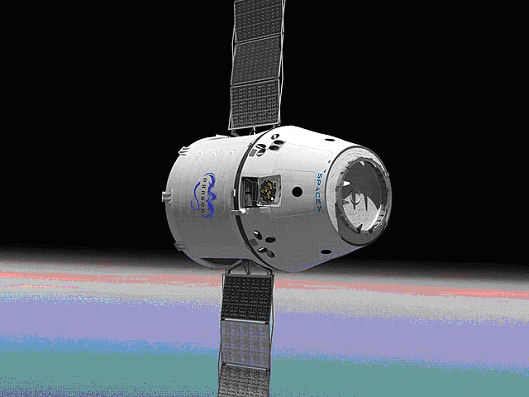 The competition, sponsored by The Heinlein Prize Trust, Space Exploration Technologies (SpaceX), and the Rice Alliance gives researchers a chance to advance their projects in the ultimate laboratory—Low Earth Orbit in the microgravity environment of SpaceX’s Dragon spacecraft. The winning team also receives a $25,000 cash award, and a trip to Cape Canaveral to see their project launched into space. [image: SpaceX DragonLab]
The winning proposal says that “Microgravity yields a valuable gift for scientists to study larger particles transported over microchannels. A particular advantage of having experimental data of free diffusion not affected by gravity at the microscale is the possibility to correlate these data with similar results obtained on Earth at the nanoscale.” The experiment will have a direct impact on the development of drug delivery systems for medical applications. The team is focused on the development of implantable devices for controlled, long-term drug release, important treatment means for illnesses, including cancer.
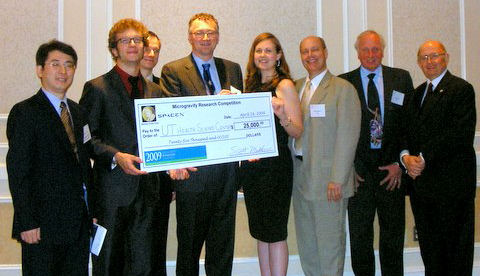 Team leader Dr. Mauro Ferrari said of the prize, “I am delighted with this historical opportunity to perform research in space and bring back the results to Earth to improve health care. This experiment will allow us to refine our technologies for the release of a drug at the right time and to the right place in the body, and to bring to the clinic the vision of personalized medicine.” Other members of the winning team include: Alessandro Grattoni, Arturas Ziemys, Daniel Fine, Enrica De Rosa, and XueWu Liu. [left-right: XueWu Liu, Alessandro Grattoni, Arturas Ziemys, and Mauro Ferrari (all of the UT Health Science Center), Erin Spengler (SpaceX), Dennis Stone (NASA), Neal Pellis (NASA), Art Dula (Heinlein Prize Trust)]
“Their work has scientific implications that go far beyond just academic science,” said Art Dula of the Heinlein Prize Trust.
The experiment is currently expected to be launched aboard SpaceX’s second demonstration flight of its Dragon vehicle, in November. The mission will fly from Cape Canaveral, Florida, for four and a half days in orbit, and then splash down off the coast of California.
Science fiction grand master Robert A. Heinlein and his wife, Virginia, founder of the Heinlein Prize Trust, believed in and advocated a human future in space where, in the words of Mr. Heinlein, there is, “unlimited room, unlimited energy, unlimited wealth,” to benefit every person on Earth. The Heinlein Prize Trust continues his legacy by encouraging private space activities such as this Microgravity Research Competition. The Trust is a non-profit foundation which promotes the commercial uses of space. It provides financial prizes to commercial space entrepreneurs, enhances public awareness of commercial space, and uses space to inspire students about opportunities of the next frontier.
Links: full press release is available here.
For more on the Heinlein Prize Trust, see this page.
For more on the LabFlight mission, upon which the winning project will fly, see this site.
SpaceX is on the web at this site.