 [Note: this review first appeared in my “Guest Reference Library” column in the January/February 2009 issue of Analog Science Fiction and Fact.]
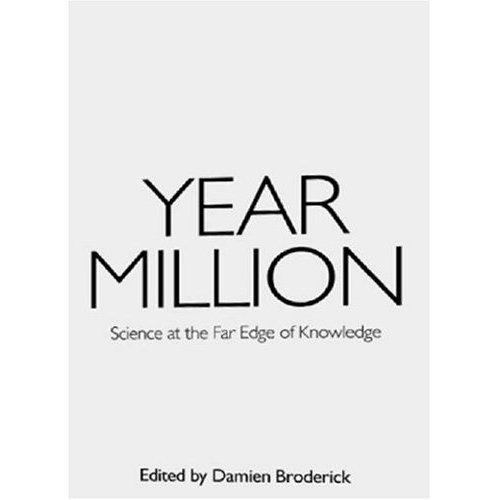
Year Million: Science at the Far Edge of Knowledge edited by Damien Broderick
Atlas & Co., $16.00, 336pp, tp, 9780977743346.
Year Million is a collection of essays, ostensibly describing what life will be like a million years from now. It’s an excellent source ideas for the writer looking for stimulus. For the reader interested in the future, there are a lot of thought experiments that involve the reader in the process of extrapolation. Ultimately, though, the book falls victim to its incredibly long view of the future: given enough years, anything that is not forbidden will happen. And that’s what we get when the contributors (mostly Analog authors and PhDs) start extrapolating too far into the future.
I was hooked when I found fascinating ideas that are broadly applicable in the first two essays. And for the most part, the essays maintained my interest and kept me reading through to the end. But at some point, it simply becomes a travelogue of all the wonders that may be, rather than extrapolation of how we get from here to there, and what will happen as we go.
Right off the bat, Jim Holt (in “The Laughter of Copernicus”) grabbed me with his simple version of the Copernican Principle, which I found myself applying everywhere I could. His explanation, that “you’re not special,” says the odds are that nothing we see has just started or is about to end (the odds of not seeing the first 2.5% or the last 2.5% are, by definition, 39-to-1). And the book is even littered with throaway lines that will keep you thinking (for instance, Catherine Asaro’s “The progress of the human race could be described as the history of how we didn’t know what we didn’t know”). Wil McCarthy scoffs at Star Trek‘s transporters, but offers an alternative possibility: sending ourselves all over the galaxy via fax. Robert Bradbury moves on to redesigning the solar system more to our liking (or to a form we can more easily make use of). Rudy Rucker’s “The Great Awakening” talks of technological telepathy, which may be simply a by-product of ubiquitous nanotechnology, and he makes it sound good.
Broderick has divided the fourteen essays into four sections (“The Expanding Human Universe”, “Deep Space in Deep Time”, “The Mind/Body in Year Million”, and “Into the Very Deepest Future”), but I see it as simply moving from more concrete extrapolations (“How will the human body evolve?” “How will we live among the stars?”) to more abstract blue-skying (“Is the universe open or closed?” and “What form will intelligence take in a run-down universe?”).
Most of the contributors to this collection should be well known to Analog readers. They include: Jim Holt, Dougal Dixon, Steven B. Harris, Lisa Kaltenegger, Catherine Asaro, Wil McCarthy, Robert Bradbury, Robin Hanson, Pamela Sargent & Anne Corwin, Amara D. Angelica, Rudy Rucker, Sean M. Carroll, Gregory Benford, and George Zebrowski.