 [Note: this review first appeared in my “Guest Reference Library” column in the January/February 2009 issue of Analog Science Fiction and Fact]
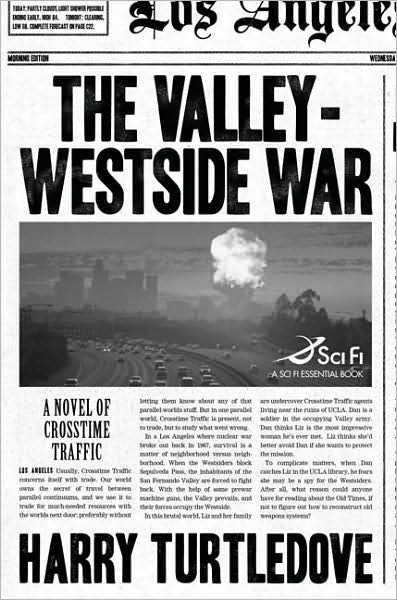
The Valley-Westside War by Harry Turtledove
(a Crosstime Traffic novel), Tor, $24.95, 288pp, hc, 9780765314871.
The Valley-Westside War is the sixth book in Harry Turtledove’s “Crosstime Traffic” series, but it works just fine as a stand-alone novel. The series is set in the many parallel worlds accessible through the technology discovered by the company Crosstime Traffic. This particular story is set a century and a quarter after a nuclear war didn’t destroy the planet, but did knock all of humanity back to a pre-electricity era. Buildings are left, along with a partial knowledge of the time before, but none of the comforts the home timeline is used to. In this milieu, Liz and her family are researching the causes of the nuclear war. They know it happened in 1967, but they are trying to figure out who started it (the US or the USSR?) and why.
Teenaged Liz has recently graduated from high school in the home timeline, and is on assignment with her researcher parents. She’s thinking of becoming a crosstime researcher herself, and is hoping to bulk up her resume before entering college. Her parents’ grant has sent them to this timeline, where they’re living as traders in the mini-kingdom known as Westside. The cover works, as Liz spends most of her days at the remains of UCLA, in the library, reading 150-year old copies of Time, Newsweek, and any other contemporary news sources she can find.
Her research is threatened when the neighboring kingdom of The Valley invades Westside, in response to the Westsiders attempting to charge their neighbors a toll through the wall across the 405. The war is limited in the ways of war with bows and arrows, a few flintlocks, and the exceedingly rare high-powered guns from a distant past must be. Indeed, one machine gun discovered by the king of the Valley is enough to turn the tide, and suddenly Liz and her family are living under an occupying force while trying to continue their research. Keeping their heads down as unremarkable traders wouldn’t be terribly difficult… if Liz hadn’t attracted the attention of Dan, a soldier in the Valley army who is smitten with her.
Young Dan has the stirrings of intelligence that is untapped in this world. It isn’t just Liz’s looks and attitude that keep Dan coming back. He isn’t sure if she’s different, or suspicious, so he keeps coming around. Liz, for her part, finds him an uncultured savage, and barely tolerates his attention, which of course makes Dan suspect even more.
Dan’s suspicions and intelligence also come to the attention of his superiors, he is promoted, and life becomes too hot for Liz and family. They flee, only to return through another transposition chamber to try to continue their research. Unfortunately, as with all historical research, there is never a definitive answer.
Liz and Dan are fully fleshed-out characters, though most of the rest seem little more than ciphers to me. all in all, this is an interesting exploration of what a post-apocalyptic world might be, and how our more advanced descendants might interact with it.