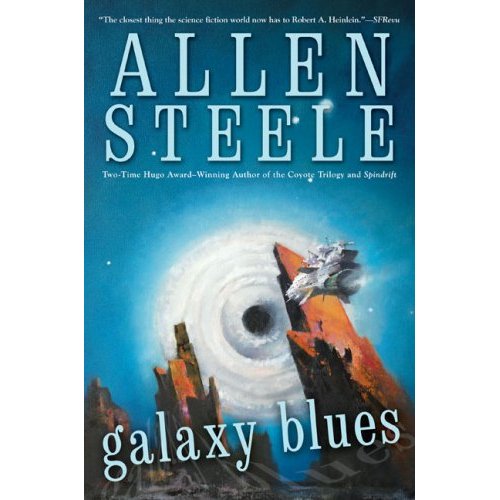
 Galaxy Blues by Allen Steele
Ace, $24.95, 336pp, hc, 9780441015641. Science Fiction.
The latest installment of Allen Steele’s ongoing Coyote series is an excellent showcase of his storytelling ability. Galaxy Blues is only peripherally connected to the original trilogy, but is a stand-alone sequel to Spindrift. In this book, we get to see far more of Morgan Goldstein (the richest man on two planets), Ted Harker and Emily Collins (the survivors of mankind’s doomed first deep-space mission), and the interstellar civilization only hinted at in the earlier books (the Talus). The characters are fully fleshed, fully realized people (from the drunk mind-reader to the overbearing capitalist to the vaguely reptillian alien ambassador); the alien society is truly alien (and, just as we’d sense it if we were really there, we know there’s a lot more of it than we can take in in the brief time we have); and the dangers our heroes must overcome are truly dangerous, with equally valuable rewards for success.
Like his previous novels, this one was originally serialized in Asimov’s Science Fiction.
Warning: there are spoilers below. If you’d rather not know anything else about the story, know that this book is recommended as a good, easy read.
Steele has a penchant for telling his stories through the eyes of outcasts, and this book is no exception. Jules Truffaut is trying to escape the overbearing government of the Western Hemisphere Union that we’ve met (and battled) before. Truffaut was a spacer, but lost his position due to some mishap or other. Unfortunately, a man with such experience is not easily let out of the country, and he has to use not a little subterfuge, guile, and daring to achieve his escape. Fortunately for Truffaut, he lives in a world where there’s an entirely different planet to which he can defect, if only he can get there. His escape, arrival, and attempted defection make up the first quarter of the book.
Following his arrival on the colony planet of Coyote, Truffaut is in danger of being deported right back where he came from, until Morgan Goldstein comes along and offers him a position on a risky mission: the first interstellar trading mission to the Talus. When faced with the choice of prison and deportation, versus a dangerous spaceflight to experience the unknown, Truffaut doesn’t have to think long. The old freighter which is the only ship Goldstein could get hold of in time is an able vessel, crewed by experienced spacemen (Harker and Collins, along with man who built the ship and the helmsman), a raw recruit who got there through family connections (the love interest, Rain Thompson), and our hero. Goldstein, the mysterious Mr. Ash, and the alien ambassador represent the passenger complement.
Goldstein is off to trade several tons of marijuana with the aliens who find it a delicious herb. In exchange, he expects the wonders of alien technology: interstellar drives, nanotechnology, something. What he gets stuck with, however, is little more than trinkets. The aliens, of course, have different ideas for how they’d like this trade mission to turn out. Misunderstandings occur, insults are assumed, and our intrepid band of adventurers find themselves in a very hot situation: they can either undertake the terribly dangerous mission they’ve already turned down, or they can die a unpleasantly far from home.
Of course, they accept the mission. Now their job is to deliver a probe to a moon that is hours away from annihilation. A huge, moving black hole, that has already destroyed the home worlds of several sentient species, is on track to get another, and the Talus is unwilling to risk themselves to plant the probe, but they’re quite happy to have this new, young species do it for them. Well, we’re humans, and we succeed.
But what do you do if you’re the interstellar civilization, and you’ve just found a new species that’s willing to take the risks you aren’t? Think they’ll have the backbone to stand up to you?
Steele, as always, tells a good story. I enjoyed this one.