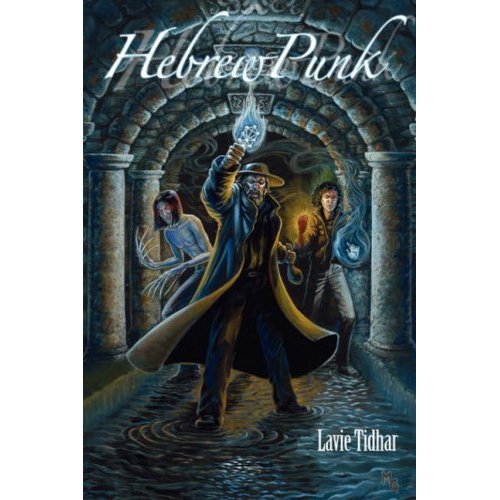
 Hebrew Punk by Lavie Tidhar (introduction by Laura Anne Gilman)
Apex Publications, $13.95, 152pp, tp, 9780978867645. Fantasy collection.
Lavie Tidhar has done something that is apparently very rare in fantasy: mixing typical fantasy tropes (vampires, zombies, werewolves, demons, and more) with Jewish mysticism (tzaddiks, golems, and most of the mishpachah). And he’s done a very good job with it, too. The four stories in this collection might be considered one tzaddik’s story, or perhaps one rabbi’s, and they might even be considered a fix-up novel, except that they appear in reverse chronological order (I don’t think that’s a nod to the Hebrew language being read right to left).
Warning: spoilers ahead. The wrap-up appears below the “End of Spoiler Space” mark farther down the page.
“The Heist” is a short story about a bank hold-up. All I need to add is the word “vampire,” and you know what kind of bank. But consider that one of the symbols to ward off a vampire is a cross. What happens when the vampire is Jewish?
“Transylvania Mission” is set with a gang of resistance fighters in Europe under the Nazi occupation. Jews and Nazis don’t mix, and when the Nazi strike-team are actually werewolves… well, it’s a good thing the Jews have their own shape-shifter.
“Uganda” is an interesting story, told through a variety of viewpoints and methods (diary entries, interview transcripts, letters, outright narrative, and more) of the search for a Jewish homeland in the first decade of the 20th century. We all know that the United Nations Partition Plan of 1947 established that state in the territory of Palestine. When I was a tour guide at Niagara Falls, I heard a story that, for a time, Grand Island, New York, had been offered as that homeland. In “Uganda,” however, Tidhar tracks the ill-fated expedition to place the new state in southern Kenya, on a nearly uninhabited plateau.
Finally, we have “The Dope Fiend,” set in the Roaring ’20s England. If you were an out-of-work immortal, you, too, might overimbibe. Especially in an era with plentiful cocaine, opium, and more. But when a fallen tzaddik has a run-in with a ghost, a demon, Baron Samedi, and more unsavory characters than you can shake a hash pipe at, he has to think fast to save his life and the world around him.
End of spoiler space.
As Laura Anne Gilman says in her introduction, “Lavie is mining ancient traditions and recent history to write stories of modern despair and a weird sort of redemptive compassion, messing with our expectations and always, always, leading with our humanity, even when the heroes are, by some standards, monsters.” Well said.
As a non-practicing Jew, these stories make me want to investigate my religion’s mythos a bit more. But whether you’re Jewish or not, these are good stories.