
I’ve been trying to write a review of this year’s World Science Fiction Convention, but I’ve finally realized there’s no way for one person to review a convention that had 12 or more tracks of programming, 8-20 parties per night, and more than 5,000 attendees in six levels of convention space extending three floors underground plus a dozen or so above-ground floors in a 35-story tower all in the space of five days (plus my several days travel time bookending the convention). In other words, there was a LOT happening from August 30th to September 3rd at the Hyatt in Chicago.
So I’ll offer my view of the goings on. You can mesh it with other reports around the web to get a handle on what you missed, or you can take it as one person’s view of the biggest science fiction convention of the year (excluding the comic/media conventions), and realize that it was a great time!
My convention experience started on Monday the 27th, when I drove from New York City to Schenectady to meet up with Joe Berlant. Flying was out of the question, because I was bringing four boxes of books with me (that was nothing to Joe’s six boxes; mine were to sell, his were to get signed and bring home). We left Schenectady Tuesday morning, and I relearned how to drive a car with standard transmission. Driving through the Buffalo area made me feel bad about not stopping, since I’d lived there several years, and have a handful of recently re-acquired friends in the area, but it was a Tuesday afternoon, and we had a destination to get to. I waved as we drove on through. Then it was through the narrow part of Pennsylvania, and into Ohio. We stopped for the night in Toledo (I was raring to go, but in retrospect, Joe was right to stop). The next morning, we were back on the road, through Indiana, and on into Chicago, rolling up to the hotel about noon, and feeling alert and rested.
Getting out of the car (before we’d even started to unload it), I ran into Sheila Williams (the editor of Asimov’s Science Fiction) who gave me the news that Analog Editor Stanley Schmidt was retiring (and that I had two hours of exclusivity to get the story posted on SFScope before the word was spread: see this article). We gave the bags to the bellhop, I checked into the hotel, and without going up to the room, I sat down in the lobby to post the news article.
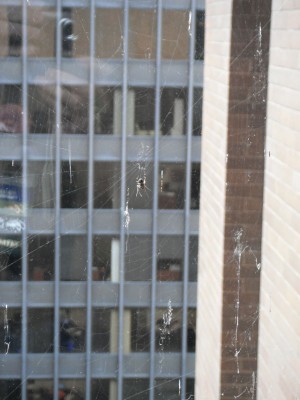
Spiders outside my 33rd floor hotel room at WorldCon.
Photo by Ian Randal Strock.
Then it was up to the room. We were on the 33rd floor in the east tower (the parties were all in the west tower), so I was surprised to find a big spider web and spiders outside our window. The body of the largest spider was nearly an inch long, and there were several smaller ones in the same web complex. I saw them moving about, so I guess that’s where they live. I, however, was destined for lower levels (and better food). Down in the dealers’ room (buried in the lowest level of the convention space), we were helping Larry Smith set up his bookselling booth (and delivering half the books I’d brought to fill his wholesale Fantastic Books order).
Registration (one floor up from the dealers’ room) was open and without crowds, so I picked up my badge. Then I got started on the ribboning. Well, I only collected four of them, but I saw several people throughout the convention with more than 40. Some ribbons are official (I collected a Program Participant ribbon and a Dealer ribbon); many others are created and distributed by individual attendees, either for the fun of it or to promote something. I was handing out ribbons that read “Shh! It’s a Secret!”—a promotional ribbon for Daniel M. Kimmel’s forthcoming novel of the same title (see this page for more information on the book).
The convention didn’t officially kick off until Thursday noon, with eleven program items scheduled for that time block. My first panel was at 1:30, “Why Editors are Your Friends”, with Barbara Galler-Smith (the Fiction Editor of On Spec magazine), Jim Frenkel (editor at Tor Books), John Helfers (editor at Tekno Books), and Lynda Williams (an author published by Edge). The discussion ranged over the various roles of editors (gleaning good work from mediocre, helping authors improve their work) and turned to the difference between editors employed by publishing houses and freelance editors. The panel was in a very nice ballroom, with huge windows overlooking Wacker Drive and the Chicago River (so it kind of distracted me), and the fifty or sixty people in attendance felt lost in that huge space. On the other hand, 60 people for only the second panel of the convention (and a fairly dry topic), on a Thursday afternoon, struck me as a very good turn-out.
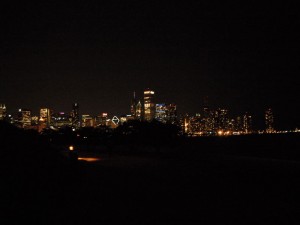
The view of Chicago from the Adler Planetarium on the night of 30 August 2012.
Photo by Ian Randal Strock.
Friday started with more time in the dealers’ room (it took me most of the convention to acclimate to the feeling of not having a dealers’ room table; I’ve been a dealer at just about every convention I’ve attended [most recently for Fantastic Books] for the past bunch of years), where Mike Walsh of Old Earth Books and Philip Kaveny of Hedgehog & Otter Books both agreed to take some Fantastic Books books on consignment. Friday afternoon was my kaffeeklatsch (small group discussions with program participants, limited to 10 or 12 people), but since it was at the same time as 23 other program items (including the interview with Guest of Honor Mike Resnick), I wasn’t surprised that no one signed up. I sat at the table, expecting to be there for ten minutes, just in case someone showed up, but expecting to be free. Instead, I met a couple of inventors from California who seek out undersubscribed kaffeeklatsches. We wound up talking for an hour and a half about what I do in sf, and what they do (inventing things they expect companies will want in the next year or three, and then licensing their results). It was a fascinating discussion; I’m glad I didn’t blow it off.
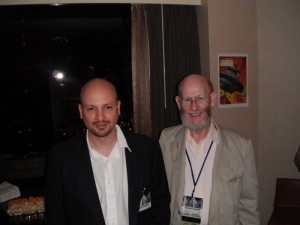
Incoming Analog Editor Trevor Quachri and outgoing Editor Dr. Stanley Schmidt.
Photo by Ian Randal Strock.
Friday night, I was torn amongst three invitations all at the same time. But after Sheila told me what was special about the Analog party that night, the choice was made for me. It was a private, invitation-only retirement party for Stan (the room was filled with Analog authors). It was a bittersweet party, as Stan was honored and his successor, Trevor Quachri (who has worked for Stan for a dozen years) was formally introduced. I’ve felt a strong connection to the magazine from the time I started working there as the editorial assistant (in 1989; gasp! can it be that long ago?) through the time I sold my first story to Stan (“Fermat’s Legacy”, which appeared in the September 1992 issue). And even after I left the job to start my own magazine, I’ve continued to write for Analog. I’m very disappointed to see Stan leave, but he has been there a long time (iconic editor John W. Campbell edited the magazine from 1937 to 1971; Stan’s 34-year tenure either ties or exceeds Campbell’s, depending on how one measures it). The image on the cake was the cover of the December 1978 issue, the first to list Stan as Editor. The same image was blown up for a retirement gift Sheila and Trevor presented to Stan. In a discussion with several of the other authors about Stan’s longevity, we were trying to figure if anyone in the room had sold stories to the magazine under Campbell’s editorship: it turned out Stan was the only one. Several of the authors dated back to the Ben Bova years (1971-78), but Stan himself was the only one to have been writing for the magazine for more than 40 years. Discussing his retirement plans, he said he and wife Joyce have already bought a house in North Carolina, where they’ll be able to do more hiking. He also plans to try writing more fiction, and hopes to continue to enjoy reading the magazine (without having to read the 99% of the submitted stories that don’t make it into print—should be a much more relaxing experience for him).
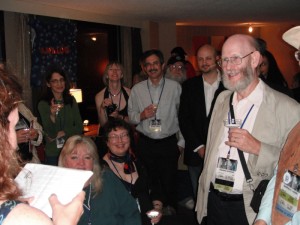
Asimov’s Editor Sheila Williams reading her tribute to retiring Analog Editor Stanley Schmidt.
Photo by Ian Randal Strock.
Saturday, my first panel was “Heinlein’s Heroes” at noon, with Deb Houdek Rule (a member of the Board of Directors of the Heinlein Society), Toni Bogolub (fan and sometime editor), and Jo Walton (who won the Hugo Sunday night for her novel [[[Among Others]]]). The panel had about the same number of attendees as my first (on editing), but in a room built for 30 people, it was packed to the walls and rafters. The discussion ranged over much of Robert Heinlein’s writing. I’ve participated in many such panels over the years (I’m a big Heinlein fan), so it was refreshing to hear different points of view from my co-panelists; their views of Heinlein’s female characters seemed at odds with most of the co-panelists I’ve heard over the years. But hey, that’s what makes panels fun: different people have different ideas. There was much emphasis on [[[The Door Into Summer]]], so much so that I’m going to have to reread it. And I was the first to mention both Heinlein’s short fiction, and his posthumous collaboration with Spider Robinson, [[[Variable Star]]]. A great discussion which filled the allotted time and kept me thinking about it afterward.
Saturday afternoon I did something I don’t think I’ve ever done at an sf convention before: I sat for an hour playing a game. Walter Hunt, another Fantastic Books author, is also a friend of mine, and a fairly well-known game designer. I ran into him and his wife wandering through the concourse, and they convinced me to sit down for a little while, and they taught me a game. I mention it more as an example: in addition to the explicitly sf goings-on, there’s time to just relax with interesting people, learning new things.
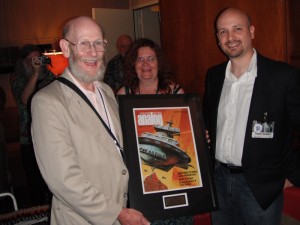
Stanley Schmidt accepting an enlargement of the cover of the first issue of Analog to list him as Editor, presented by Asimov’s Editor Sheila Williams and Schmidt’s successor, Trevor Quachri.
Photo by Ian Randal Strock.
Saturday at 7:30 was “Do We Need Paper Books?” with Amanda Luedeke (an agent with MacGregor Literary), John Teehan (of Merry Blacksmith Press), Joy Crelin (editor at Circlet Press), and Steve Saffel (editor at Titan Books). Attendance was a bit sparse, but we were running opposite the Masquerade (which is one of the two biggest draws at WorldCon, along with the Hugo Awards ceremony). The discussion, as you’d imagine from the title, focused on the coming of ebooks and whether they will join or replace printed books. I mentioned the joy of reading a book to a child, wondering if an ebook could ever replace that (think Pat the Bunny). Fortunately for the discussion, Saffel’s wife was in the audience (she’s the head of new media for Harper’s childrens books division), and she had the goods on ebooks for kids and picture books in electronic format: apparently, they’ll be here sooner than we think, and probably be pretty darn good. We didn’t really reach any conclusions (can such a panel ever?), other than the assumption that the final word on the subject won’t be written by those of us on the panel: it’ll be in the hands of the next generation, or the one after that, those who are growing up with ebooks as a matter of course. That panel was my last bit of programming during the convention, but I was by no means finished.
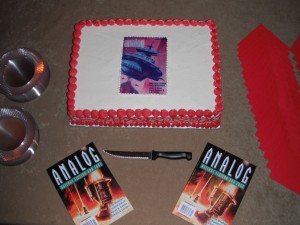
The cake at Stanley Schmidt’s retirement party, showing the cover from the first image to list him as editor (December 1978). Flanked by copies of the current issue (the last issue of Schmidt’s editorship will be March 2013).
Photo by Ian Randal Strock.
After the panel, I went out to a late dinner with Tanglwyst de Holloway and John Farmer from Fantastic Journeys Publishing, who I’d just met the day before. We talked some business, but they’re so much fun to hang out with that we wound up sitting in the restaurant for a couple of hours, and then went for a little late-night walk through the streets of Chicago (I’ve never explored the city before). We didn’t go far, but I was fascinated by the Chicago Tribune Tower, a gorgeous building built in 1922, with a collection of famous building fragments studding its outside wall, and a wonderful stone and wood lobby with a friendly guard on duty who told us the relief map of North America over his shoulder was made from retired US currency. We got back to the hotel after midnight, but there was still time for partying (I know, it probably sounds like my only focus was parties, but a lot of business is actually conducted at those parties: I met dozens of people, talked about the books I’m publishing, learned what other people are doing, and expect to sign a few deals as a result of those conversations). (On the other hand, I also had a lot of fun, talking with those people from all over the globe, discussing their homes and what they do, eating and drinking a little too much, and getting too little sleep.)

“The Future of Analog” panel on 2 September 2012 at WorldCon. Panelists (from left to right): Trevor Quachri, Stanley Schmidt, Brad Torgerson, Richard Lovett, and Catherine Shaffer.
Photo by Ian Randal Strock.
Sunday morning I got up early (well, early for me) to attend the 10:30 panel on the future of Analog. The room was packed with readers and writers, and after the announcement at the start of the convention, the other panelists probably felt themselves superfluous. Brad Torgerson, who I just met this weekend, successfully moderated the panel that included authors Richard Lovett and Catherine Shaffer. But they were overshadowed by outgoing editor Stanley Schmidt and incoming editor Trevor Quachri. I usually find it difficult to attend panels when I’m not one of the panelists (too much experience talking, I guess), but this was a panel I had to be at. Apparently, there were a lot of people who agreed with me, who love the longest-running magazine in science fiction.
Sunday afternoon, Toastmaster John Scalzi interviewed Guest of Honor Story Musgrave. The ballroom for this presentation was full, and I wound up standing in the back (with dozens of other people). There must have been 600 people in the room. Scalzi started things rolling by reading Musgrave’s bio (read it here; it only seems to be fiction), and then asked him a leading question. Musgrave responded, asking if he could tell a little story, to which Scalzi replied “I can guarantee that no one is in this room to hear me.” We were treated to more than an hour of Musgrave’s stories about his life and experiences (he was, among other things, the oldest active-duty astronaut, the first to fly six different space missions, and the only astronaut to fly on all five Shuttles). It was a wonderful hour-plus. I only managed to copy down two of his thoughts, as I was too busy soaking it in (others recorded the session, and I’m sure it’s available somewhere out there). Talking about traveling and learning new things: “You don’t conquer space; you surrender to it. That’s how you learn another culture.” On the comic side, a general observation about life: “A lot of things are okay until something bad happens. In parachuting, it’s not okay until something happens.” He also talked about standing up on the upper deck of the Space Shuttle during re-entry, to film the plasma around the tail of the craft (I’m looking for that footage, if anyone can find a link).
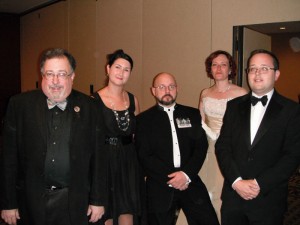
Nominees for the Best Related Work Hugo Award before the ceremony. (L to r): Daniel M. Kimmel, S.J. Chambers, Howard Tayler, Mary Robinette Kowal, and Graham Sleight.
Photo by Ian Randal Strock.
Then it was time to get ready for the Hugo Awards. I’ve never been a Hugo nominee, but since Dan Kimmel couldn’t come up with a better date, he invited me along as his “plus one” for the evening’s festivities (I’m the publisher, he’s the author). Things started with the pre-ceremony reception for nominees and their guests: it was a room full of elegantly dressed, nervous people, chatting and nibbling. I got a few minutes to talk with Story Musgrave, and also spent some time with Robert J. Sawyer and his wife, David Kyle, and several others. Brad Torgerson was wearing his dress uniform (he’s a Chief Warrant Officer in the Army Reserve), making every other guy in the room look like a schlub by comparison. Then it was in to the ceremony (which I described in this article). When the ballot was first announced, I assumed that the Science Fiction Encyclopedia would win in the Best Related Work category. But throughout the convention leading up to the ceremony, I heard so many nice things from so many people (both friends I’d had going in to the convention, and people I met there), that I started to think Dan’s book had a chance of winning. Alas, it was not to be. But we’re both still thrilled to have had the nomination.
After the ceremony, the non-winning nominees were whisked upstairs (by a service elevator, avoiding the crowds) to the traditional Hugo Losers Party (hosted by the following year’s WorldCon; in this case, LoneStarCon 3). This is a big-ticket event at WorldCons, since admission is so limited. They had nice food (barbecue) and an open bar (as a non-drinker, that’s never such a big thrill for me). It was a room full of elegantly dressed people commiserating with each other, into which they allow the winners after they’re finished posing for photographs and such. Dan and I decided it was too downbeat a gathering, and we headed out after an hour or so for the more upbeat, open parties to be had elsewhere in the hotel. That’s when we made it to the Spokane in 2015 WorldCon bid, co-hosted by my high-school era friend Marah Searle-Kovacevic. I think I’d seen her briefly in passing once up to that point. And that’s one of the problems of a WorldCon: there are so many people that it’s depressingly easy to not see someone even once during the entire convention. On the other hand, there’s some law of large groups that keeps people coming back together. Wednesday afternoon I was sitting in the hotel lobby doing a little work on my computer, and a fellow interrupted to chat (why else would someone work in public, except that he’s hoping to be interrupted). Somehow he’d recognized me as a program participant (he actually had my schedule on his netbook), and we talked for a few minutes. As we were parting, he remarked that we’d probably not see each other again during the convention, but I reminded him that the other possibility was that we’d run into each other at least four times a day; turns out it was the latter. Oddness.
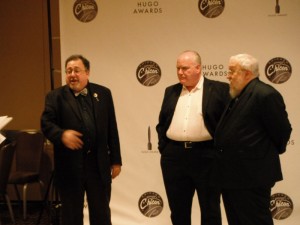
Nominees and acceptors for the Best Dramatic Presentation, Long Form Hugo Award, before the ceremony. (L to r): Daniel M. Kimmel, Ron Donachie, and George R.R. Martin.
Photo by Ian Randal Strock.
At any rate, Sunday night Dan and I finished making the rounds of the parties, cheered ourselves up, and eventually called it a night.
Monday morning, Joe and I got back on the road for the drive to Schenectady, electing to do it in one long stretch (it took us about 13 hours). After a brief nap, I then made the final four hour drive home.
What I somehow didn’t work into the above review is the art show, with about 100 artists showing some wonderful work. Self-trained wire sculptor Elizabeth Berrien was demonstrating her techniques and discussing her work. Japanese cover artist Youchan (and her agent/translator) were discussing just how different Japanese cover designers’ ideas are from their US counterparts. I always enjoy Alan Beck’s work. Others that caught my eye (and had cards on their displays) include Todd Johnson’s ShockFossils (which included a short video loop explaining how they’re created: fascinating); Colleen Kobe’s art (which is visually similar to Johnson’s, but quite different in execution); Tom Peters’ spacecraft work; and John Douglass’ hand-built custom spaceships. I don’t mean to slight any artist I didn’t mention here, mind you, there were lots and lots of exceptional pieces on display and for sale.
There was also the concourse, which had tables for upcoming WorldCons (the previously mentioned LoneStarCon 3, Loncon 3 [which won the bid for 2014]) and bids for WorldCons farther in the future. There was also a display of the history of the Hugo Awards, and a display of space paraphernalia (honoring guests Story Musgrave and Sy Liebergot), and a fanzine lounge. The con suite (right outside the art show) was a 24-hour-a-day gathering place to sit, nosh, and talk. The lobby, and the occasionally open hotel bar also served as places to meet and greet.
The bar at most every convention is a gathering place for writers and editors talking business. I’m kind of surprised I spent almost no time in this bar (although the few times I walked through that part of the lobby, it was closed: strange hours, I guess). On the other hand, WorldCon is one of the few conventions to have a dedicated SFWA Suite for members and their guests, so much of the at-bar discussions probably wound up there.
I’ve mentioned by name only a vanishingly few of the dozens of fascinating, fun, interesting people I met during the weekend, and even fewer of those people I knew going on. I don’t mean to slight anyone, but I’m still assimilating everything, and I didn’t want to mention one without the other. But rather than faulting me for so few names, why not plan to go next year yourself, and make your own memories.

Stanley Schmidt suddenly realizes that “retiring” means actually leaving and giving the job to someone else, and considers canceling Trevor Quachri and remaining on the job.
Photo by Ian Randal Strock.
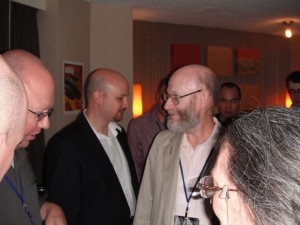
Displaying a possible qualification for appearing in Analog, Brad Torgersen, Trevor Quachri, and Stanley Schmidt show off their skulls.
Photo by Ian Randal Strock.
